
Launched at CBD COP17 in Yerevan, the report explores how gender-responsive Nature-based Solutions (NbS) can strengthen climate resilience, protect biodiversity and support more equitable livelihoods across Sub-Saharan Africa.
How can global biodiversity commitments translate into meaningful action for people and nature? A new report from NAbSA offers practical insights from 11 projects implemented across Sub-Saharan Africa under Canada’s Partnering for Climate (P4C) portfolio.
Using the IUCN Global Standard for NbS, Desarrollando la resiliencia: Soluciones basadas en la naturaleza para la adaptación examines project experiences and identifies opportunities to strengthen implementation, monitoring and long-term impact.
Putting communities at the heart of resilience
NbS can address climate change and biodiversity loss while supporting the livelihoods of communities that depend on healthy ecosystems. However, delivering lasting results requires more than good intentions: it demands locally led action, sustained investment, meaningful participation and robust evidence of impact.
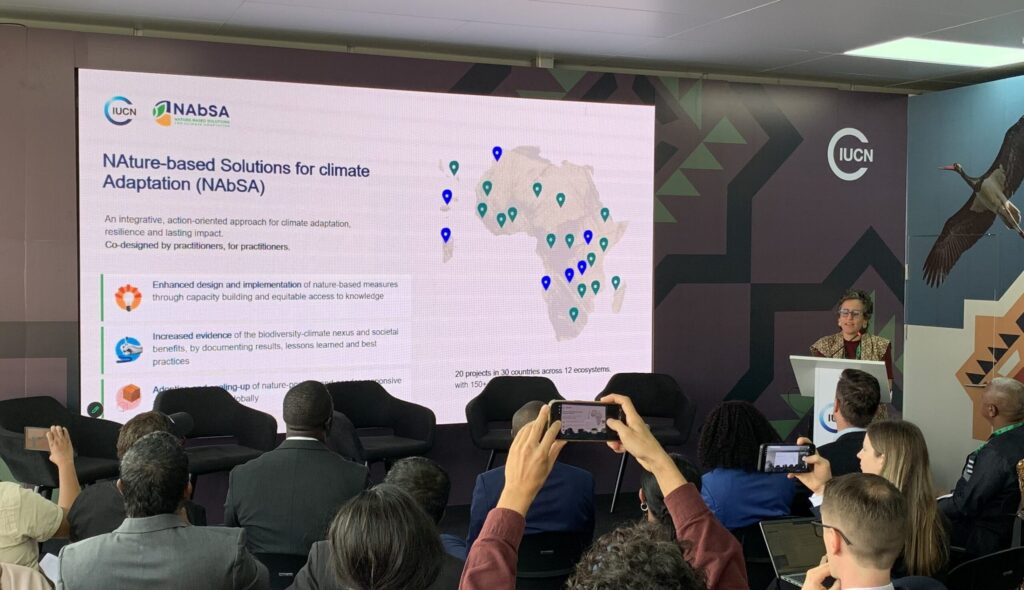
In 21 October, at the CBD COP17 event in Armenia, Scaling Regenerative Seascapes: Nature-based Solutions and the Case for Investment, Verónica Ruiz Garcia, Senior Climate and Resilience Manager at IUCN, highlighted the role of women and local communities in restoring ecosystems and strengthening coastal resilience.
“Picture a woman in Senegal’s Sine-Saloum delta. In her lifetime, more than a quarter of the mangroves around her have disappeared, and with them went the fish, the oysters and the shield against the sea. Today she isn’t waiting for help. With other women in her community, she is planting the mangroves back, one seedling at a time.”
Verónica emphasised that lasting impact depends on practical guidance, long-term financing and partnerships rooted in local realities, with community-led action informing national plans.
Four lessons for effective Nature-based Solutions
Drawing on assessments against the IUCN Global Standard for NbS, the report identifies four priorities:
- Integrate biodiversity and climate action: Design interventions around local ecological conditions and community needs.
- Put people and rights at the centre: Strengthen women’s leadership, inclusive participation and equitable natural resource governance.
- Improve monitoring and accountability: Measure outcomes for biodiversity, climate resilience and human well-being to support learning and demonstrate impact.
- Invest for the long term: Build lasting partnerships, sustain financing and align local initiatives with national priorities.
These lessons are particularly relevant as countries gather at CBD COP17 to advance implementation of the Kunming–Montreal Global Biodiversity Framework (KMGBF). The report offers practical experience to inform ecosystem restoration, inclusive governance, biodiversity monitoring and resource mobilisation, while highlighting the importance of safeguards and quality when scaling NbS.
Through NAbSA, IUCN and its partners are sharing evidence and strengthening capacities to advance gender-responsive NbS that benefit both people and nature.
Explore the report and discover how project experience can help turn global commitments into lasting resilience.
This report was developed by IUCN through the NAbSA initiative, with contributions from project partners across Canada’s Partnering for Climate portfolio, funded by Global Affairs Canada.