
As the world marks World Environment Day 2026, the global conversation is focused on climate change and the urgent signals the Earth is sending. This year’s campaign calls on everyone to step in, go further, and help steer a world already in motion.
But one of the clearest signals may already be coming from communities themselves.
Across Africa, women are restoring ecosystems, strengthening food security, protecting biodiversity, and helping communities adapt to climate change. Yet despite their leadership on the ground, their voices remain largely absent from the policies designed to shape climate action.
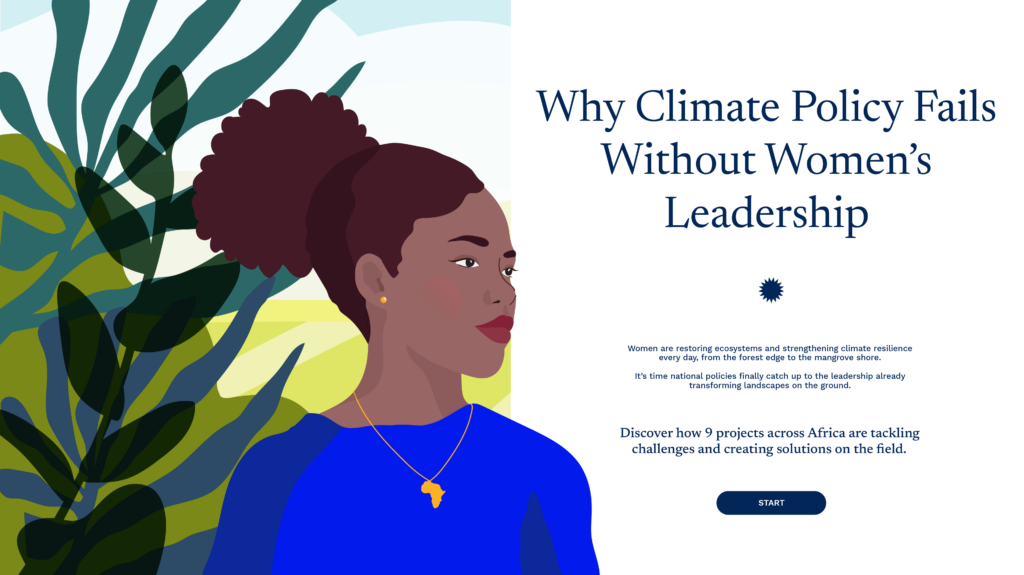
To coincide with World Environment Day, NAbSA’s Policy & Governance Task Force has launched a new dynamic storytelling product: “Why Climate Policy Fails Without Women’s Leadership.”
The product brings together evidence and stories from across Africa to highlight a critical gap in climate governance: the disconnect between women-led Nature-based Solutions (NbS) and the national policies intended to support climate adaptation and resilience.
Across diverse landscapes, from drylands in the Sahel to mangrove ecosystems along the coast, women are already implementing solutions that respond directly to climate impacts. They are restoring degraded land, managing forests and fisheries, strengthening livelihoods, and leading community-based governance systems.
Yet national climate and biodiversity policies often fail to reflect their realities, knowledge, and priorities.
The storytelling product argues that this is not a failure of women’s leadership. Rather, it is a systemic failure to recognize, support, and institutionalize that leadership within decision-making processes.
Drawing on case studies from Chad, Senegal, Morocco, Guinea, Kenya, Tanzania, and Côte d’Ivoire, the product highlights both the scale of women’s contributions and the barriers that continue to limit their influence. These include unequal land rights, limited access to education and information, socio-cultural norms, unpaid care responsibilities, and governance structures that undervalue local and community-based knowledge.
At the same time, the stories demonstrate what becomes possible when women gain access to decision-making spaces. From influencing land governance frameworks in Chad to shaping fisheries management plans in Senegal and strengthening coastal governance in Tanzania, women are already improving climate and biodiversity outcomes where opportunities exist.
Released on a day dedicated to environmental action, the product carries an important message: responding to climate change requires more than ambitious targets and investments. It requires listening to the people already driving solutions.
The product calls for greater efforts to secure women’s resource rights, institutionalize their representation in governance structures, strengthen their capacity for policy engagement, and create formal mechanisms that connect local knowledge with national planning processes.
Developed by Alinea International, Canadian Foodgrains Bank, Farm Radio International, the International Institute for Sustainable Development (IISD), Mission Inclusion, SOCODEVI, and UPA-DI Développement International through NAbSA’s Policy & Governance Task Force, the storytelling product reflects a collaborative effort to elevate lessons from the field into actionable policy insights.
As climate impacts intensify, the message is clear: if climate policy fails to recognize and support women’s leadership, it risks overlooking some of the most effective adaptation solutions already being implemented.
This World Environment Day, as the world considers the signals it will send in response to climate change, the product offers a powerful reminder that the future of climate resilience depends on ensuring those already leading change are heard.
The storytelling product is available in English, French, and Spanish.
About NAbSA
Coordinated by IUCN, NAbSA is part of Global Affairs Canada’s Partnering for Climate (P4C) initiative. Together with other P4C projects and Canada’s Nature-positive agenda, it works to advance Nature-based Solutions for climate adaptation, supporting resilience, biodiversity conservation, and sustainable development.